Universe Today
(This is Part 3 of a series on whether the universe can be cyclic. Read Part 1 and Part 2 first.)
Enter the ekpyrotic theory. An attempt to beat inflation at its own game.
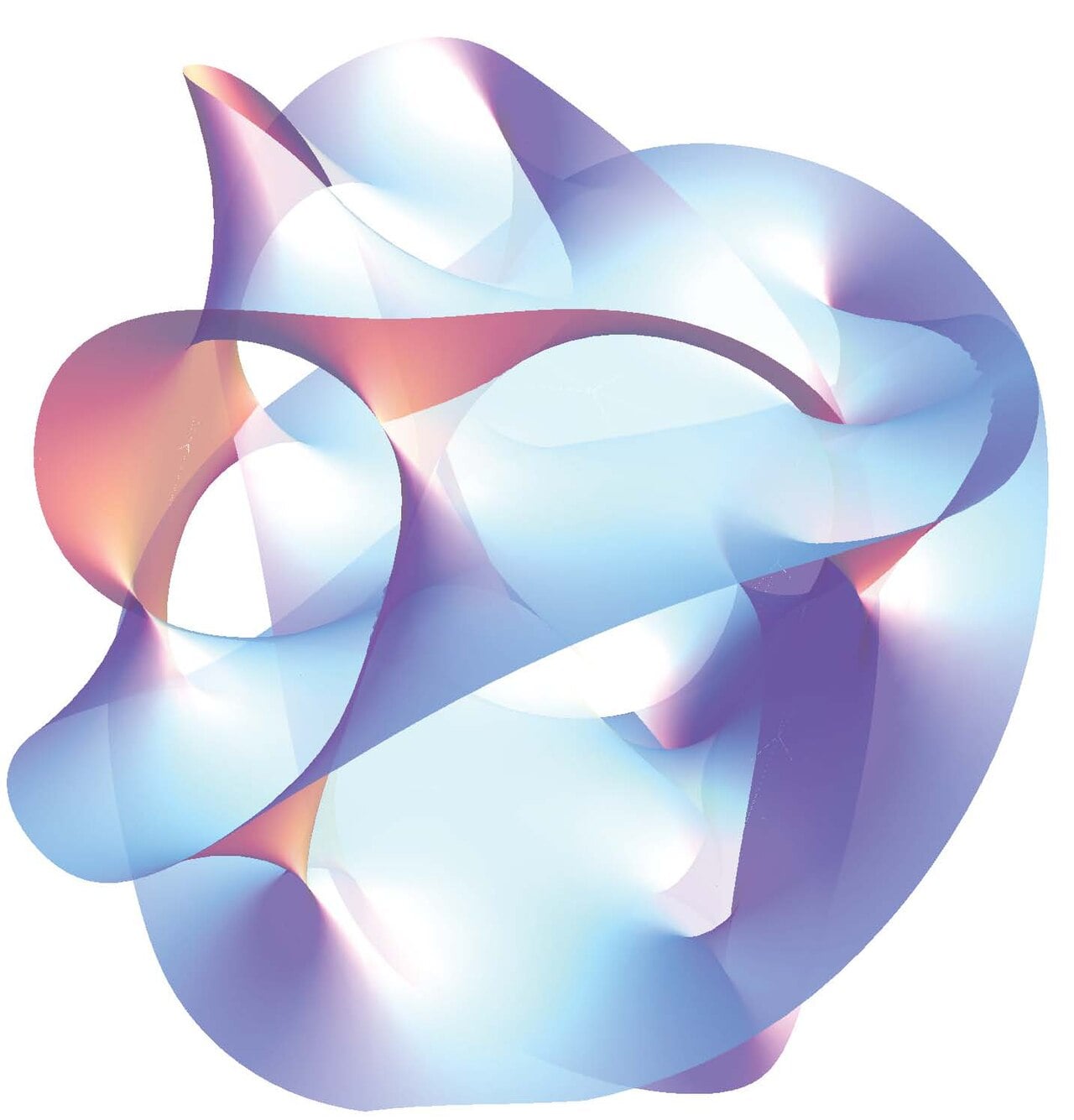
I should warn you up front. The math behind ekpyrotic theory is beyond gnarly, and it is also, in all likelihood, not entirely trustworthy, because it lives inside some of the more esoteric branches of string theory. And string theory is itself an esoteric branch of physics. So we are way, way out here in the deep end of math-speculation-game-land, where the diving board is theoretical and the water may or may not exist. We are not going to follow the math. Instead we are going to follow the pretty picture the math claims to be painting. And it really is a pretty picture.
Let's start with the foundation. Ekpyrotic theory says that our universe is a brane. Not a brain. A brane, short for membrane. Picture our entire three-dimensional universe, everything you have ever seen or touched or imagined, as a vast sheet floating in a higher-dimensional space. And as our colleagues down the hall in the string theory department will happily tell you, wherever there's a brane, there's also a bulk: the larger arena that the branes drift around in.
Here is the image to hold onto. Think of the universe as a bedsheet hung out to dry, rippling in the wind, except the sheet has more dimensions than you can comfortably picture and there happens to be more than one of them (please don't try to visualize this too literally, it does not end well). Most of the time, two of these parallel sheets hang near each other without ever touching, each one a complete universe blissfully unaware of the other. But every so often they drift together. And when they finally meet, there is a sudden release of energy that ripples out across both sheets before they rebound and pull apart again.
That's it. That is our Big Bang.
Not a single point of infinite density. Not a singularity. Just our universe colliding with its neighbor in a higher-dimensional space and bouncing off. We only experience it as a Big Bang because we are stuck living on the sheet. We cannot peel ourselves up off the brane and float out into the bulk to watch what is really going on. From our flat little vantage point, the collision looks like the fiery birth of absolutely everything.
There are a great many versions of this idea, so I'm going to weave together a reasonable middle path to give you the general shape of the story.
First, the rosy, everything-is-solved, we-can-all-go-home version. Ekpyrotic theory claims there is no singularity. No point of infinite density from which everything emerges. Just two sheets, drifting in the higher-dimensional wind, attracting each other, bouncing, releasing energy, separating. And if the universe plays its cards right, the sheets can do it all again. And again. And again. In fact, the theory says, they have always been doing this, and they always will. Our universe eternal, repeating, cyclically bouncing off itself to trigger fresh rounds of creation.
This is where the name comes from. Ekpyrotic is lifted from an old Greek Stoic concept meaning "out of fire," the belief that every so often a great cleansing blaze would consume the entire world and reduce it all to ash, giving creation another chance to begin. And here is our universe doing exactly that, wiggling around the bulk, burning and resetting and burning again.
Oh, and there is no more inflation. None needed. The slow approach of the two branes can be arranged to lay down ripples in spacetime that behave precisely like the ones inflation produces, the seeds of all future structure. So you still get your atoms, your galaxies, your cosmic web, all the good stuff a working cosmology is obligated to deliver.
What about flatness, the problem that gave the standard Big Bang such fits? Handled. As the branes draw together, the energy density of the universe climbs rapidly, swamping any leftover curvature and ironing the whole cosmos flat. The horizon problem, with its mysteriously coordinated temperatures? Also handled. The branes take a long, leisurely time drifting toward each other, more than enough for everything to settle into quiet agreement before the bounce.
And dark energy? Here is where it gets clever. Ekpyrotic theory doesn't so much explain dark energy as flat-out require it. The two branes spend an enormous stretch of time simply doing their own thing, drifting and expanding, and that drawn-out expansion is exactly what we measure today as dark energy. But eventually, far into the future, dark energy switches off. That shutdown is what finally allows the two branes to begin their slow fall back toward each other. So to kick off a new cycle, all you have to do is wait. A hundred trillion years, give or take, long after the last star has guttered out, and the sheets will drift together and bounce, igniting a brand new Big Bang exactly as they always have.
And the entropy problem, the one that killed Tolman's cyclic dream and every model since? Ekpyrotic has an answer for that too, and it is the cleverest move of the lot. Tolman's trouble was that entropy stayed trapped inside the universe: you build it up, then you crush it down with nowhere to put it. But in the ekpyrotic picture the universe never crunches. It keeps right on expanding the whole time. So you dilute all that accumulated entropy across a staggeringly enormous volume before you trigger the next bounce. It is essentially a cheat code, resetting your entropy to nearly nothing with every single cycle.
So take a step back and look at what we've got. One universe. Always existing. Bouncing off itself in a higher-dimensional space. Powered by dark energy, whatever that turns out to be. Resetting its own entropy. Seeding all of cosmic structure. No inflation. No singularity.
As ideas go, that is NOT BAD. In fact, it's good. It's really good.
It's just a shame that it doesn't work.
In Part 4, we find out exactly where this beautiful idea runs headfirst into the one judge that doesn't care how pretty your math is: nature.